
By Jett Peters
Introduction
Most of us have had the opportunity to appreciate the beauty of the aurora borealis/australis, but this natural phenomenon gives rise to a number of fascinating questions. In this blog, we will tackle them!
We will uncover:
- What causes the colors of an aurora?
- Why do there appear to be only three colors?
- Why do the colors not appear to mix?
The purpose of this blog is not to answer our three questions with as much rigor as possible. The physics at play within each question is extremely complicated, and many processes remain open research questions. The goal is to stay truthful to the physics and underlying mechanics while simplifying as much as possible to preserve readability.
There is a complex chain of events culminating in the production of an aurora. We will only focus on the final step in this chain: light production. This will suffice to answer all of the above questions, and we’ll start with charged particles (mostly electrons) colliding with the upper layers of the atmosphere.
Atmospheric Composition
Before we enter the discussion of aurora at all, we need to take a moment and understand the composition of the atmosphere. The atmosphere is made up of a number of types of gases; at different elevations, they can be found in different quantities. For example, while oxygen gas (O₂) is extremely common at low elevations near sea level, it vanishes in the highest layers of the atmosphere. Furthermore, the air becomes thinner at higher altitudes; there is just less gas in a given amount of volume.
To understand the full picture of atmospheric composition, we can employ the following graph from the NRLMSIS 2.0 model.
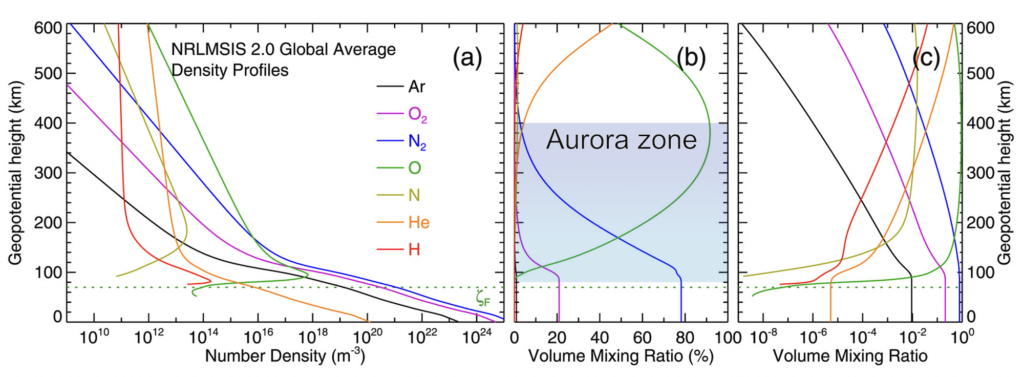
Figure adapted from Emmert et al. (2021), NRLMSIS 2.0, Earth and Space Science.
This graph admittedly looks extremely complicated, but we only need information from the second panel (b). Auroras can be found from about 80–400 km above the surface, meaning we are only concerned with this range on the plot.
The colored lines correspond to different gases in the atmosphere, and panel B tells us the elevation on the y-axis and percentage of the atmosphere on the x-axis. In the aurora zone (highlighted in blue) there are only two gases which make up a significant portion of the atmosphere:
- Molecular nitrogen (N₂) corresponding to the blue line
- Atomic oxygen (O) corresponding to the green line
The percentages of these two gases change with height, and this is an important detail. Referring to the plot, at lower elevations in the aurora zone, molecular nitrogen is more common than atomic oxygen, but at the highest elevations in the aurora zone, atomic oxygen dominates the atmosphere.
What causes the colors of an aurora?
The colors of an aurora are caused by the emission of a photon by either of our two gases (molecular nitrogen or atomic oxygen) after becoming excited. Most people already carry the rough version of how that excitation happens: something collides with the gas, and the gas lights up. That concept is exactly right, and it’s where we’ll begin.
We’ll look first at how oxygen can be excited by a collision with a charged particle, then move on to nitrogen. At the end we’ll swing back around to oxygen to explore a slightly different method of excitation. The goal is to explain why light is emitted at all and how that happens in our two gases.
Atomic Oxygen: Electron Collision Excitation
As a charged particle plows into an atom of oxygen in the upper atmosphere, it transfers some of its kinetic energy in the collision, and that energy goes into kicking one of the atom’s electrons up to a higher energy level. When this electron eventually drops back to a lower energy level, it emits a photon of a specific wavelength. The wavelength or color of light is specified by the energy gap between the initial and final states of the transition. Depending on the gap, these transitions occur over different timescales: some happen almost instantaneously while others take over a minute.
Atomic Oxygen: Excited States Achievable in an Aurora
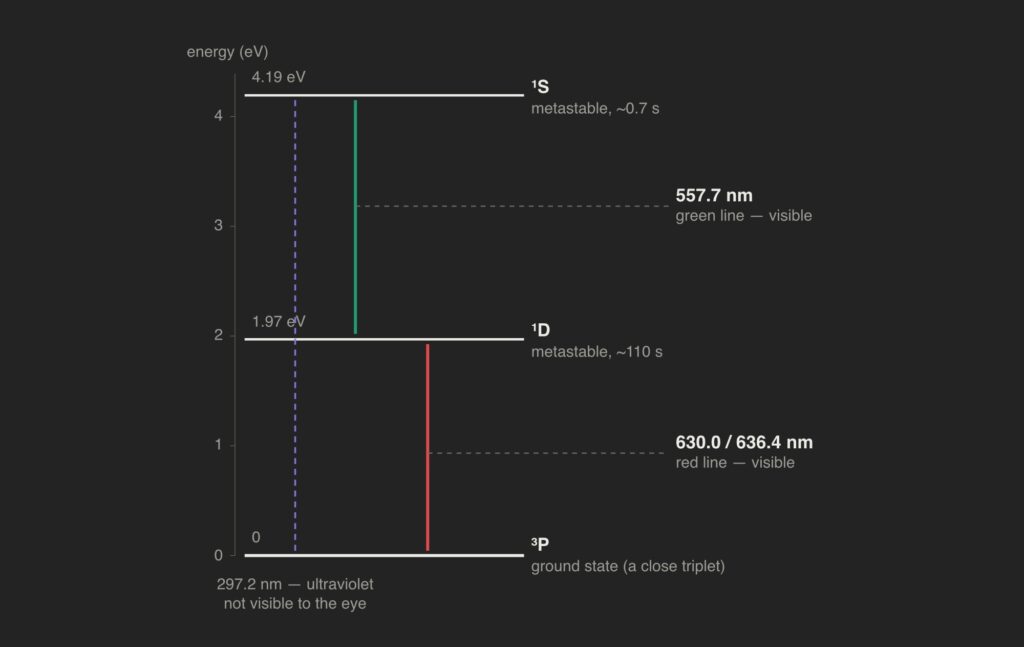
There are two excited states of oxygen achievable in an aurora. These states are shown in the following diagram. We refer to the higher energy excited state as ¹S and the lower energy excited state as ¹D. This diagram also illustrates the time difference between the two transitions. Going from ¹S to ¹D takes about 0.7 seconds, while going from ¹D down to the ground state takes 110 seconds. We will refer back to this diagram in the next question.
Molecular Nitrogen: Electron Collision Excitation
A diatomic molecule (like N₂) is two atoms locked together by a bond, and that bond can stretch while the whole molecule tumbles. Oxygen has only one way to store energy, in its electrons, but N₂, because of its structure, can stash energy in vibration and rotation as well. The core mechanism is still the same as in a single atom: an electron drops to a lower level and a photon carries off the energy difference. But now two extra quantities (rotation and vibration) fine-tune that photon’s wavelength. The molecule begins in some vibrational and rotational state of its upper electronic level and lands in some vibrational and rotational state of the lower one. The exact wavelength of the photon depends on both.
This is why we cannot include a simple diagram that shows diatomic nitrogen’s excited states. They’re an extremely complicated set of overlapping levels that are only achieved in certain circumstances.
Atomic Oxygen: Molecular Collision Excitation
Now that both gases are on the table, a second route to exciting oxygen opens up. At certain elevations within the aurora zone, both molecular nitrogen and oxygen exist in significant percentages. In these layers it’s possible for an excited nitrogen molecule to collide with a ground state oxygen atom. This collision, if the state of the nitrogen molecule is correct, excites the oxygen atom. To be specific: collisions with molecular nitrogen within a specific excited state bump oxygen into its ¹S state.
Why do there appear to be only three colors?
The three colors (red, green, blue/pink) are closely related to the mechanism we talked about in the last question. The first two come from oxygen emission, but the third is a result of nitrogen.
Oxygen: Red and Green
Let’s start with atomic oxygen. Recall from the last section that atomic oxygen has two lower energy excited states: the higher energy state ¹S and the lower energy state ¹D. These two states give three possible paths, which can be shown in the following diagram.
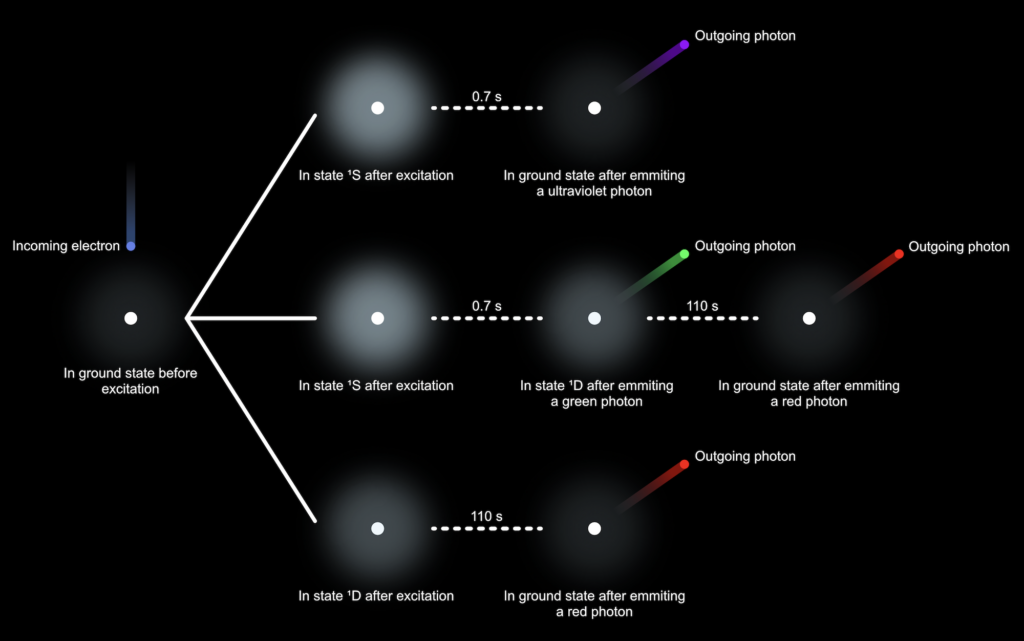
If an atom is excited to state ¹S, it could either return straight to the ground state by emitting an ultraviolet photon, or it could drop down to state ¹D, emitting a green photon, and then to the ground state by emitting a red photon. Additionally, it could only have been excited to state ¹D and return to the ground state by emitting a red photon. Humans cannot see ultraviolet light, leaving us with only two possible colors for atomic oxygen emission: red and green.
Nitrogen: Blue/Pink
Next we need to understand why excited molecular nitrogen results in a blue/pink hue. Diatomic nitrogen is more tricky. If you recall from the previous questions, the mode of emission can produce thousands of individual wavelengths. This is a consequence of the molecule’s ability to rotate and vibrate, which fine-tunes its energy levels into a plethora of possible emission colors. However, they aren’t scattered randomly across the EM spectrum. They cluster into two very distinct groups in the visible.
- When an incredibly fast charged particle hits a nitrogen molecule, it doesn’t just excite one of its electrons. It kicks an electron completely out of the molecule, giving rise to an excited ionized nitrogen molecule (N₂⁺). When this ion transitions back to the ground state, it emits a photon in the deep blue or violet range.
- If a slightly less energetic particle hits a normal, neutral nitrogen molecule (N₂), it excites it without ionizing it. When the molecule drops to a lower state, its vibrational transitions create a cluster of wavelengths that land in the crimson red and pink area of the visible spectrum.
We have now established the three colors that make up an aurora: red, green, and blue/pink. But as we’ll see in the next question, these do not all mix into a single hue. They are actually broken up by altitude, and the mechanism is fascinating!
Why do the colors not appear to mix?
When you look up at an aurora, you will notice that the colors don’t seem to mix. Instead, they seem to be broken out into distinct structures rising from about 100 km above the surface to way up into the atmosphere. This is not an optical illusion, as the colors are broken up by altitude, and now that we’ve answered the first two questions, we have the ingredients, spare one, to understand why. This discussion will be a simplification, but it stays true to the real effects at play.
The ingredient we’re missing is a very important concept that relates to the time between excitation and emission of a transition. If an atom collides with a molecule after it’s been excited but before it’s emitted a photon, it trades its energy as heat instead of light, and no emission occurs. This concept is referred to as quenching and is exactly why we placed so much emphasis on the time between excitation and emission in the previous sections. If a collision occurs in that time period, no light is emitted, and this becomes a crucial reason for why auroras are broken out by altitude, especially in the case of oxygen.
We’ll build the picture up one gas at a time. First we’ll assume the aurora zone is entirely composed of oxygen, then add nitrogen to see its impact.
Oxygen: 100–400 km
Starting from an aurora zone entirely composed of oxygen, we recall its ladder of states. Above the ground state (³P) sit two excited states: the first excited state (¹D), which decays to ground by emitting the red photon, and the second excited state (¹S), which decays to ¹D by emitting the green photon. The lower rung, ¹D, is far more commonly reached than ¹S. This is simply an effect of probability: there are more charged particles of moderate energy than of high energy, and the second excited state requires more energy than the first. If this were the only effect at work, we would expect red to dominate at every altitude, with only a faint green component, and we would expect the emission to brighten toward the bottom of the aurora zone as the density of atomic oxygen increases. But this does nothing to explain why there is significant green emission at all, or why it sits below the red. For that we have to invoke quenching.
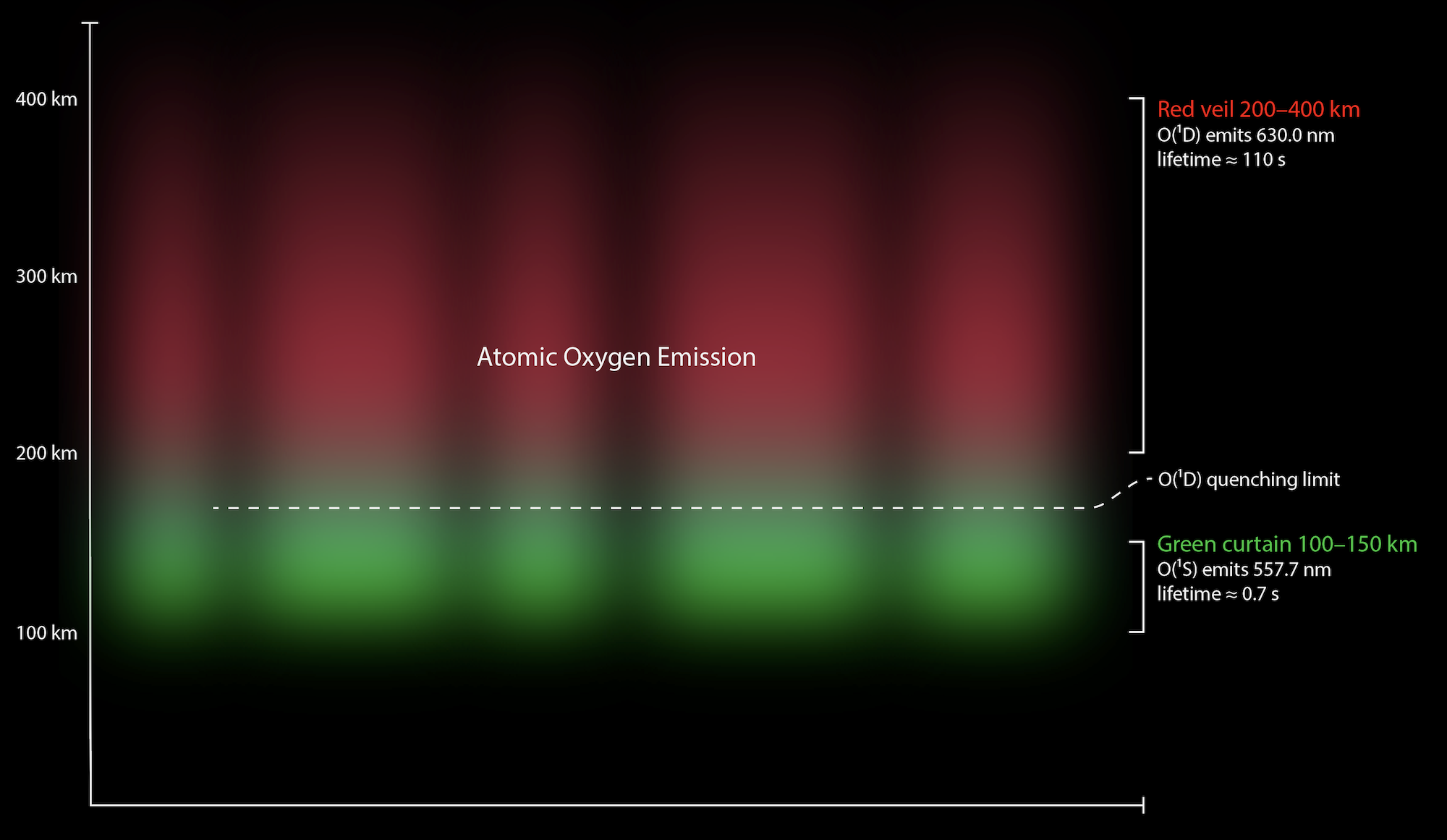
Let’s understand how quenching separates the red from green by analyzing oxygen’s excited states. The two states (¹S and ¹D) live on wildly different time scales, as we discussed in the previous sections. An atom in ¹S emits its green photon in about 0.7 seconds. In contrast, an atom in ¹D needs about 110 seconds to get the red photon off. In atomic physics, 110 seconds is an absolute eternity. At lower elevations in the aurora zone, where the air is denser, there is simply not enough time for the red. The excited atom fires off its green photon quickly, lands in the ¹D state, and then a collision quenches it long before the 110-second clock runs out. This is why we see green in the middle and lower layers of the aurora zone. Red atomic oxygen emission effectively cannot survive there. Only at the highest elevations is the air thin enough to leave an atom undisturbed for minutes at a time.
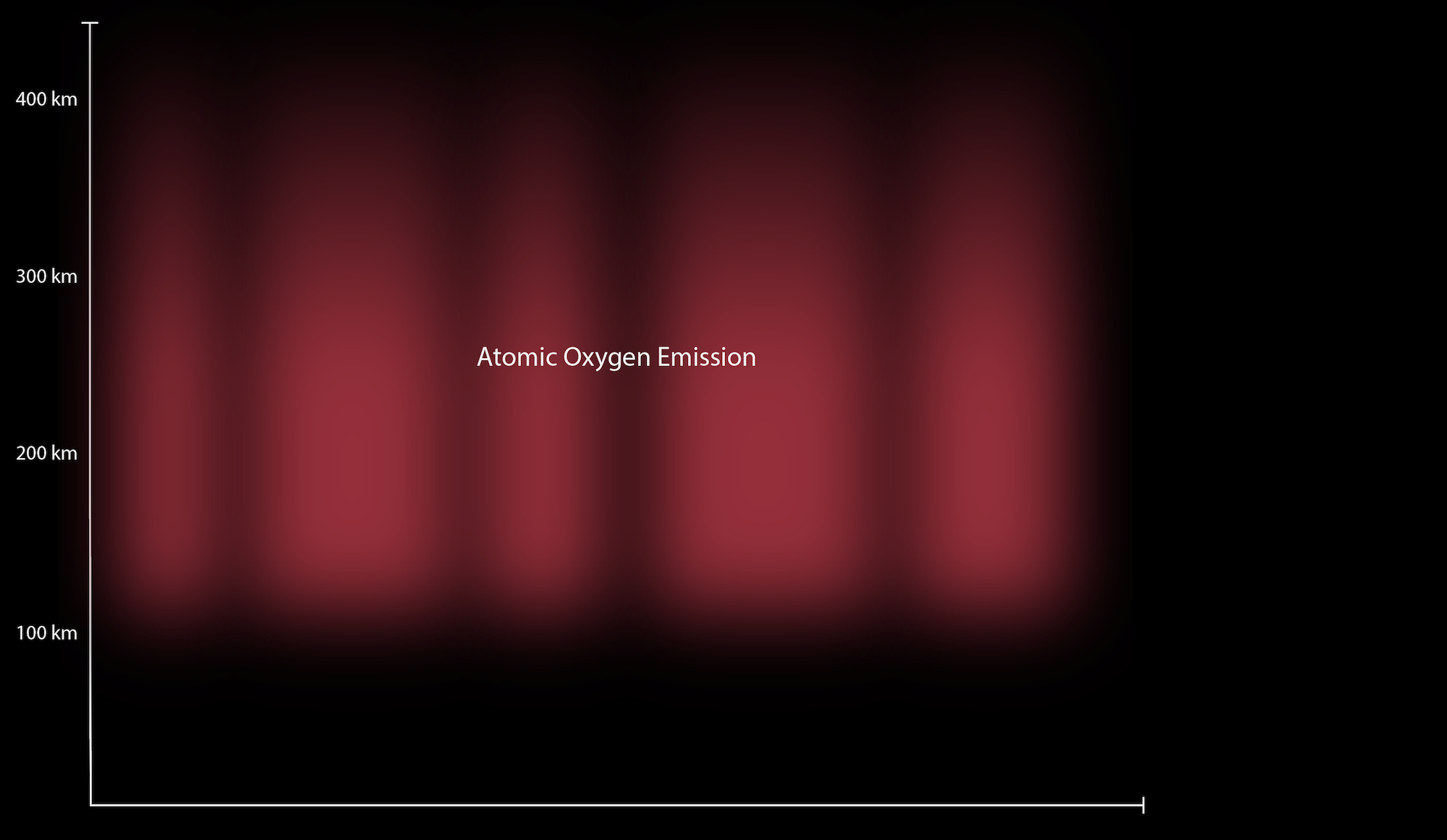
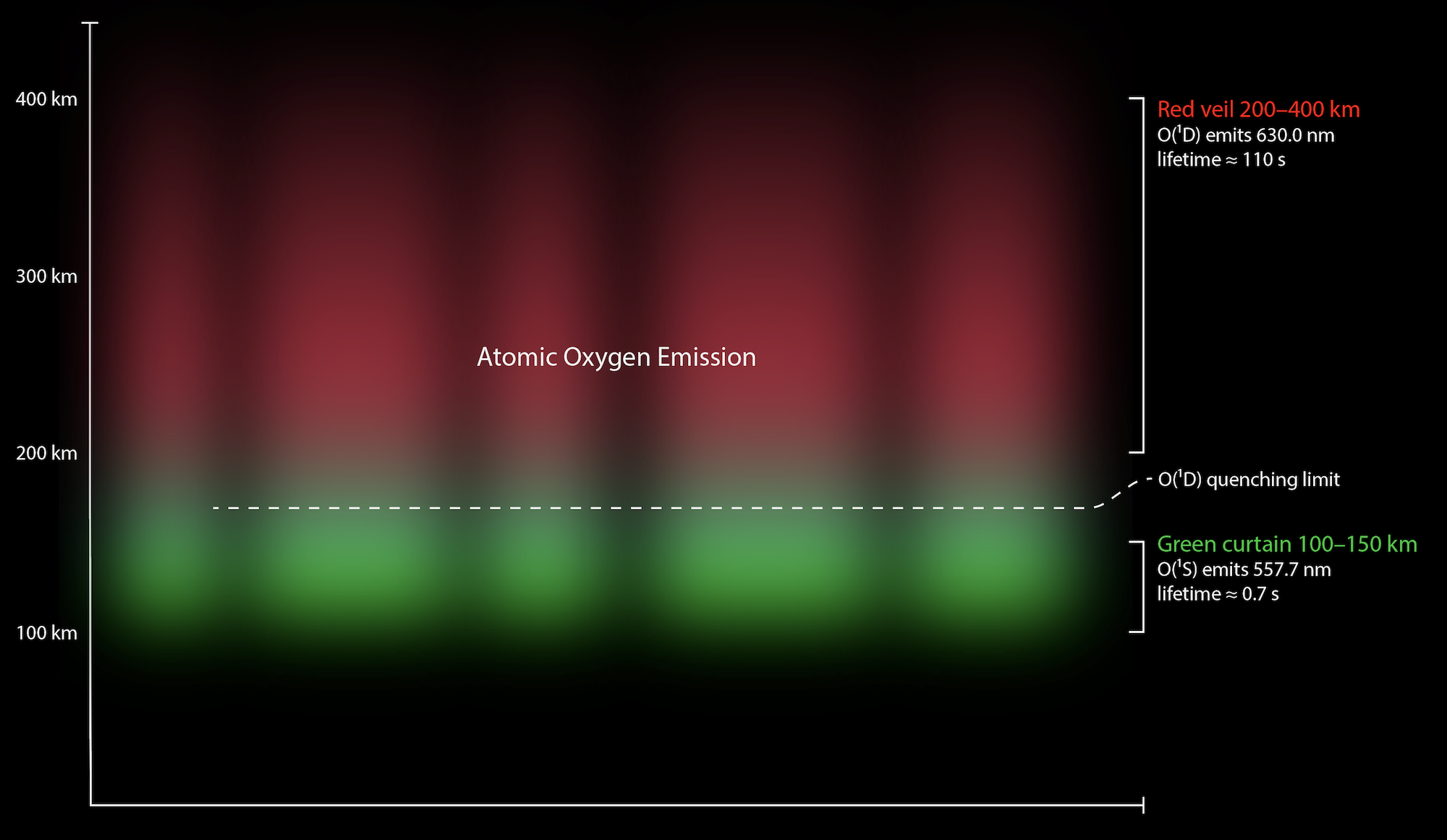
Slide to reveal the effect of quenching. Note that the lower layers would show some green even without quenching, but for simplicity the figure shows none.
You may wonder why the green goes away at the bottom. The simple explanation is that atomic oxygen diminishes in percentage at the lower levels of the aurora zone. Once we reintroduce nitrogen into the picture, another reason for the green’s disappearance will be uncovered.
Nitrogen: < 100 km
Now we add nitrogen back in.
Looking back at the plot of atmospheric composition, there is plenty of nitrogen throughout the region where the green aurora resides (100–150 km). This raises an important question: why do we see so much more green than blue or pink? The answer comes in two parts. First, an excited molecule of nitrogen (N₂) can actually hand off its stored energy to an oxygen atom, kicking it up to the ¹S state. This is exactly the second mode of excitation we discussed previously. Effectively, nitrogen can funnel even more energy into atomic oxygen. In fact, it’s proposed that this might be the main way the green oxygen is excited. Second, the human eye is most sensitive at almost exactly the green line’s wavelength, so wherever green and blue are produced together (and they are produced together, at essentially the same altitudes), the green wins.
Below about 100 km the green oxygen emission disappears for two reasons. First, the quantity of atomic oxygen falls off dramatically below 100 km. The second uses the idea of quenching but in a higher-level sense. When we invoked quenching within oxygen’s excited state, we thought of it purely as a numbers game: lower down, there are more collisions, which quench the 110-second transition. While true, quenching is a little bit more nuanced than this: only certain molecules quench certain transitions. The reason the 110-second oxygen transition is quenched at lower elevations is not only because of the number of collisions, but because there’s molecular nitrogen in that layer of the atmosphere. Nitrogen is very good at quenching the ¹D to ground state transition, but it’s not good at quenching the ¹S to ¹D. What is very good at quenching the ¹S state is molecular oxygen. While we did not talk about this gas in our discussion, it does show up in sizable quantities at the lowest altitudes in the aurora zone. It quenches the 0.7-second ¹S to ¹D transition of oxygen, condemning the green line.
The nitrogen, however, is still around, and it keeps glowing down to whatever depth the incoming electrons can punch. This is why the pink-blue nitrogen hue marks the lowest edge of the aurora: not because nitrogen lives only at low altitudes, but because that is the one region where the green no longer exists to outshine it.
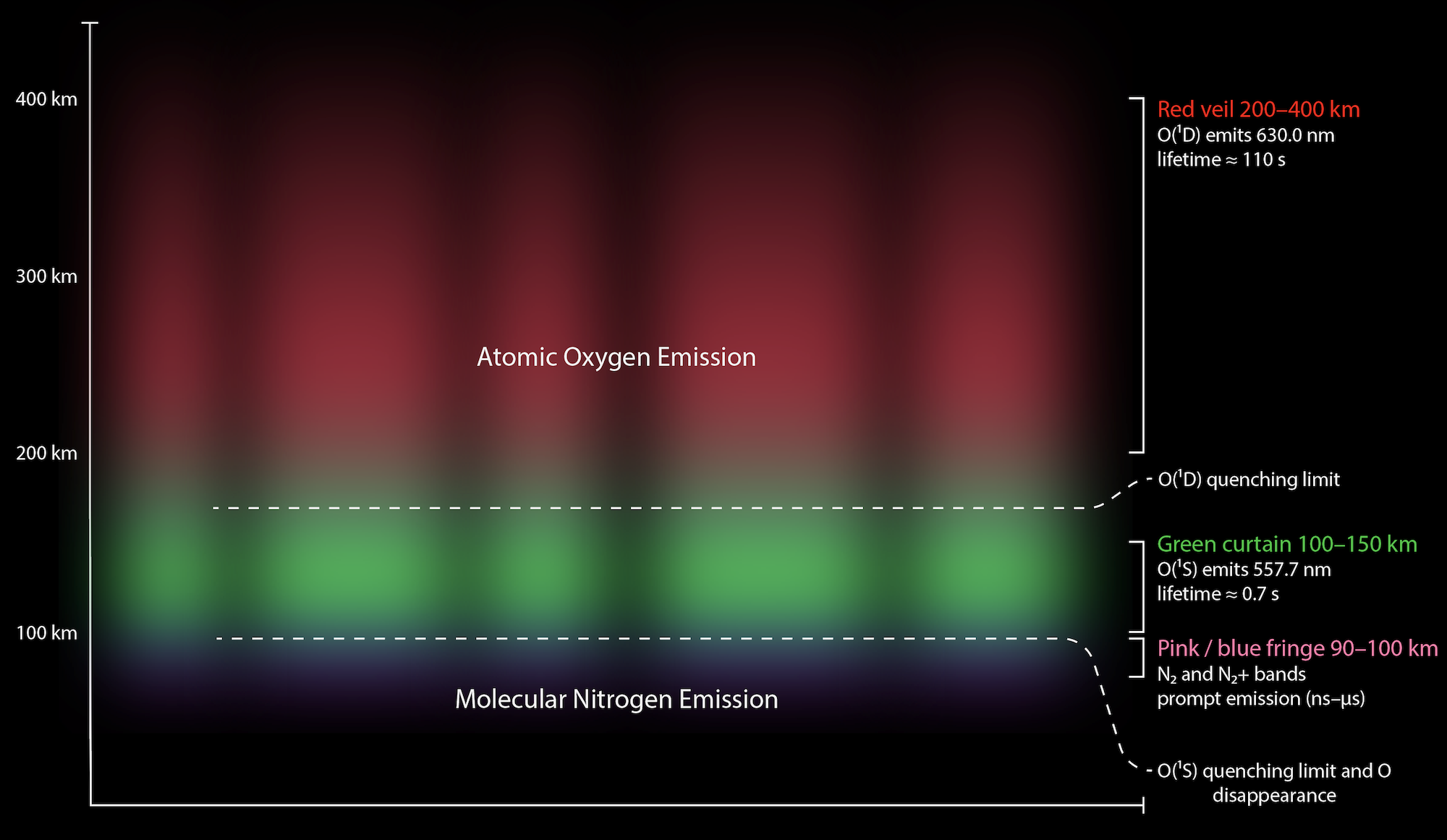
Slide to reveal the effect of nitrogen. The green should brighten, since nitrogen now funnels even more energy into it. This is a slight limitation of the figure.