
By Jett Peters
Summer 2026 offers some rare stargazing events and amazing opportunities for those of us who photograph the night sky. Mark your calendars and get ready for a summer to remember!
June’s Three-Planet “Parade”
Venus and Jupiter are reliably the two brightest planets in the night sky. Venus is bright because it passes closer to Earth than any other planet and its thick clouds are highly reflective, while Jupiter shines thanks to its massive size. What makes their presence in the sky this summer special is their close proximity to one another (1.6 degrees at their closest point). This June, you’ve likely noticed Venus and Jupiter shining brightly together in the western sky shortly after sunset. This is an example of a planetary conjunction, when planets’ orbits bring them close together as viewed from Earth. In mid-June, Mercury will join the party low on the horizon in the western sky. Mercury will reach its greatest elongation, the point at which it appears farthest from the sun in our sky, making it easier to see.
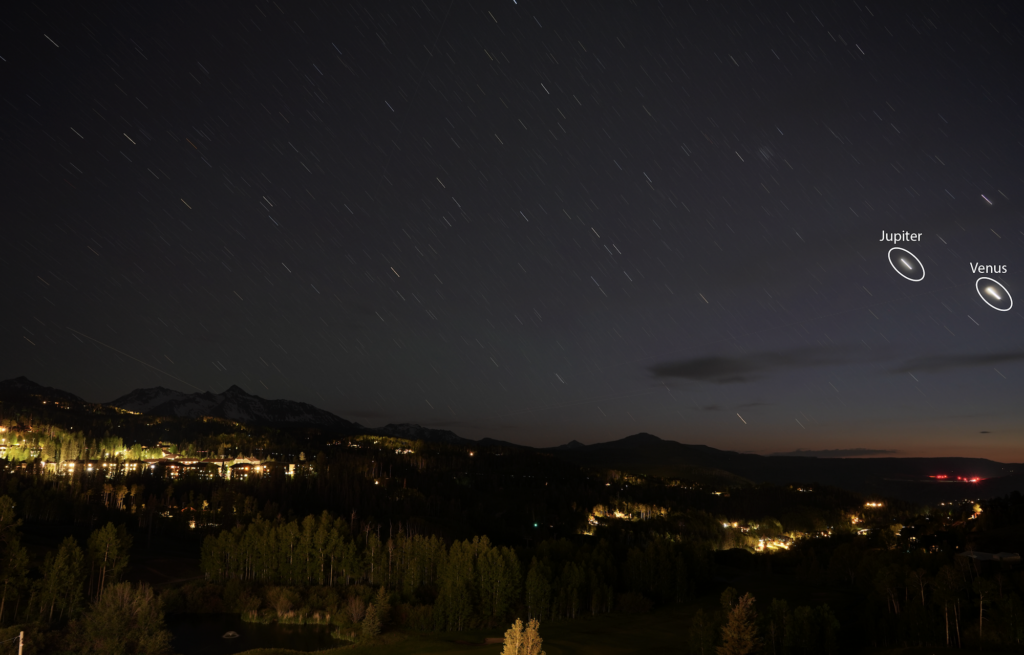
The first two members of the parade: Jupiter and Venus. The star trails are a result of the long untracked exposure.
A Stellar Perseid Meteor Shower (August 12–13)
Each August brings the Perseid meteor shower, caused by debris from Comet 109P/Swift-Tuttle. Seeming to radiate from the constellation Perseus, it reliably produces one of the best meteor showers of the year. This year, however, the Perseid meteor shower will be one for the memory books. The brightness of the moon has an oversized impact on how many meteors can be seen in the night sky, with full moons making it impossible to see a high percentage of the “streaking stars.” This year the peak of the Perseid meteor shower will fortuitously coincide with a new moon, ensuring some of the best nights of meteor viewing in years (August 12–13). The dark skies will allow viewers to see large numbers of meteors per hour and enhance the colorful fireballs we have come to associate with the Perseid meteor shower.
This year’s shower also offers opportunities for astrophotographers; the best way to capture the event is with a wide-angle lens or telescope and a color camera. The wider the field of view, the better chance you have to capture meteors. In fact, the best setup for the job is an all-sky camera. If you have access to a color planetary camera that came with a lens, you can convert it into a high-quality all-sky camera using free software like indi-allsky. The software automatically builds a time-lapse for each night, and during a meteor shower, the video will be crisscrossed with fiery trails.
Eclipses
Although the total solar eclipse on August 12 will not be visible from the United States, on August 27-28 a deep partial lunar eclipse (covering 96% of the moon) will be visible across much of the country. If you’ve never imaged the moon before with a telescope and a deep-space monochrome or color camera, partial lunar eclipses are a great option. The red color makes for a striking visual, and the moon’s diminished luminosity makes it easier to image.