
By Jett Peters
In the astronomy community, we tend to focus on the positive: the next bold mission to Jupiter, the next intricate theory of cosmology, or the stunning colors of a distant nebula. This is hardly surprising. The community is unified by a shared quality: an awe for the night sky and a fever for exploration. However, we must accept that light pollution has become an insidious threat to this unifying ideal.
I think we can all remember the moment when we first saw the Milky Way and realized that the night sky held far more than just a sprinkling of glittering lights. While this is a fond memory for many of us in the hobby, 80% of the world has never had this moment. And this number will only rise in the coming years, and our islands of darkness, where true research and photography are possible, will continue to shrink. It’s important to understand that while this may seem like a distant threat from our remote observatories and dark sky sites, the rate of light pollution is accelerating. It is not a linear threat, it is an exponential one that is often ignored by the general public.
April offers us a timely opportunity to learn and participate. Every year, April 13th through the 20th marks International Dark Sky Week, a global call to awareness organized by DarkSky International. DarkSky International, founded in 1988, is a global nonprofit organization focused on tangible impact through light-pollution advocacy. Here in Utah, concrete change has been successful. Back in 2021, Governor Spencer Cox signed a proclamation designating the entire month of April as DarkSky Month in Utah. This commitment reflects a remarkable statistic: Utah holds more certified dark sky parks and places than
anywhere else in the world.
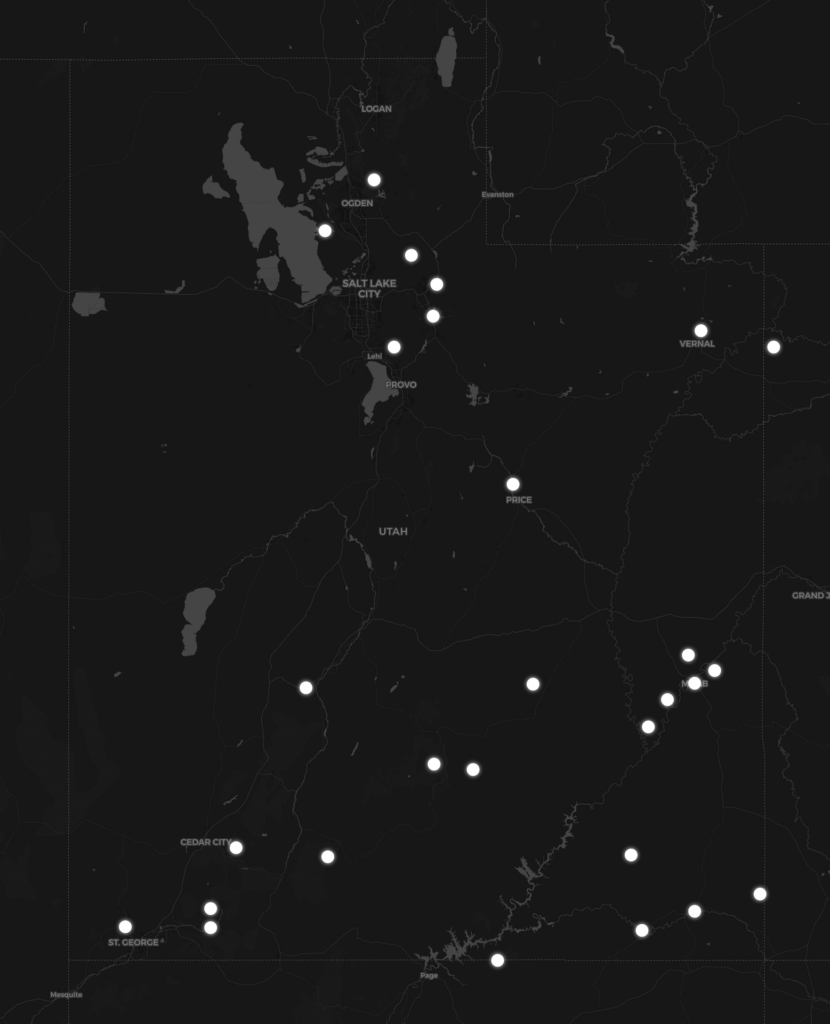
DarkSky International certified places in the state of Utah. The dark sky sites located outside of Utah span across the border.
The threats associated with light pollution represent a common misconception among the general population and even extend, to a certain degree, within the astronomy community. Losing sight of the Milky Way and the loss of contrast in astrophotography images are only the tip of the iceberg. Light pollution also impacts local wildlife, human biological rhythms, and even the climate. Furthermore it has been found that the connection between safety and brighter environments is a myth.
Over the past century, humans have steadily turned night into day. The increased light levels at night have a severe impact on the body’s circadian rhythm, decreasing the body’s melatonin production and essentially confusing the body’s internal clock. While this may seem inconsequential, research shows that circadian rhythm disruption contributes to an increased risk of obesity, diabetes, mood disorders, reproductive problems, and even certain cancers.
As you would expect, increased light levels at night disrupt plant and animal life as well, often to an even greater extent. Animals depend on the day–night cycle to time everything from sleep to reproduction. For prey animals, brighter nights thin the protection offered by the cover of darkness.
The most extreme effects can be seen in migratory bird species. Bright artificial lights can cause them to stray from their instinctual paths. Perhaps the most shocking statistic comes from nighttime collisions: it is estimated that millions of birds die from collisions with illuminated buildings each year.
Sea turtle hatchlings are similarly affected. They rely on the natural brightness of the ocean horizon to orient themselves after emerging from the nest. Bright artificial lighting can misdirect the turtles inland. A multitude of other animals, from wallabies to mice, are affected as well, many in ways we do not yet fully understand.
Turning to climate impacts, DarkSky International reports that roughly 30% of outdoor lighting in the United States is wasted. Most of this waste is due to improper light shielding. Instead of focusing light where it is needed, many outdoor lighting fixtures spread light in all directions. This not only reduces the effectiveness of outdoor lighting, but also contributes to light pollution.
According to the same DarkSky report, more effective outdoor lighting solutions could decrease power usage by between 60% and 70%. This would save about $3.3 billion annually and prevent 21 million tons of unnecessary CO₂ emissions each year. Keep in mind, these numbers are for the United States alone.
After analyzing the consequences of light pollution, it is easy to feel that the problem is beyond the individual’s reach. But the reality could not be further from the truth. Unlike other types of environmental pollution, light pollution can be reversed on a relatively short time scale. Unlike a polluted river, for example, light pollution has an immediate cause. There is no buildup of light that must slowly work its way through the system. If the majority of unnecessary lights were turned off, much of the problem would be solved today.
In addition, the scale of the action required is relatively small; it just needs to be carried out by a large number of people. If everyone was accountable for their outdoor lighting, a significant change could occur. A few simple actions include using fully shielded fixtures that direct light downward rather than into the sky, choosing warm-white bulbs with a color temperature of 3000K or below, installing motion sensors to eliminate unnecessary light, and simply turning off lights that serve no purpose.
The most powerful thing you can do this April is share what you now know to break misconceptions and educate individuals outside of astronomy. If you want to go deeper, DarkSky International makes it easy. Anyone can join, become an advocate, and access educational resources at no cost. Yet again, International Dark Sky Week runs April 13th through the 20th. Go see the Milky Way while you still can, and tell someone what you saw.