By Jett Peters
With the captivating Perseid meteor shower right around the corner, some additional information can make observing the light show all the more fascinating.
Naming Conventions
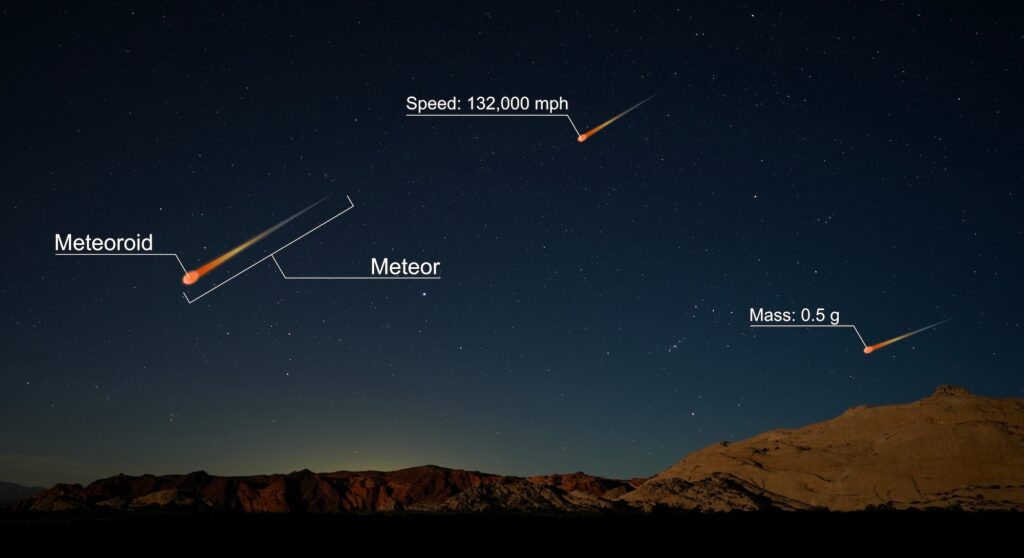
The glowing streaks that make up the shower, colloquially referred to as shooting stars, are meteors. But counterintuitively, a meteor is not an object at all. It is the streak of light produced when a meteoroid, the actual chunk of rock or metal, plows into the atmosphere and ablates. A meteorite is the piece of that meteoroid that survives the plunge and reaches the ground. Most meteoroids vaporize entirely, so meteorites are comparatively rare.
The confusion over the naming conventions associated with meteor astronomy is in part due to revisions in the definitions themselves as the field progressed. The naming convention provided above reflects the 2017 IAU revision rather than the original 1961 IAU definitions.
Size and Origin
Almost every Perseid you see is smaller than you would guess. A typical naked-eye Perseid comes from a meteoroid roughly the size of a grain of sand, weighing only a few milligrams. The brightest streaks, those at magnitude −4 and brighter, still only come from pebble-sized objects carrying just a gram or two of material. Larger meteoroids are possible, but they arrive in incredibly low numbers.
Every meteor shower originates from the same mechanism. The Earth passes through a stream of debris, and the particles in that stream strike the atmosphere at high speed, burning up as vivid streaks. What changes from shower to shower is not the mechanism but the source of the debris. In the case of the Perseids, that source is Comet 109P/Swift-Tuttle.
This comet was discovered in 1862 and still orbits the Sun on a highly eccentric path. Its period is about 133 years, with a perihelion of 0.96 AU and an aphelion of 51.23 AU. That means the comet, at its closest approach to the Sun, sits within the orbit of Earth, and at its farthest distance is outside the orbit of Pluto. Near perihelion the comet begins to shed the material that becomes the Perseids. Each tiny grain ejected from the surface of the comet may end up as a colorful streak in Earth’s night sky.
Each grain leaves the comet’s nucleus at only a few tens of meters per second, so it inherits an orbit almost identical to the comet’s. Over many revolutions those tiny differences accumulate, and the debris spreads out until it fills the entire orbital loop. That is why the shower arrives every August even though the comet itself returns only once every 133 years. Material released in recent passages has not had time to spread, and it still travels in narrow, dense trails. When Earth happens to cross one of those trails, rates climb well above normal. The comet last reached perihelion in 1992, and the years around that return produced the strongest Perseid displays of the modern record, with peak rates several times the usual level from 1991 through 1994 before settling back by the end of the decade.
Speed
The speed of the Perseids is nearly uniform: about 59 km/s, or 132,000 mph. That uniformity comes from the fact that every meteoroid in the stream follows essentially the same path around the Sun. The speed itself comes from the direction of that path. Earth moves along its own orbit at about 30 km/s, and the Perseid stream runs counter to that motion, so the two velocities largely add rather than cancel. The result is a closing speed near 59 km/s, among the fastest of any annual meteor shower.
Color
Perseid meteors do not all share the same color. Everything from violet to red has been observed. The color of a streak is often quoted as an easy way to read off the composition of a meteoroid, but it must be treated with care.
The process by which a meteor emits light is complicated. The glowing column contains excited material ablated (stripped) from the meteoroid itself along with excited atmospheric species, all of it in a plasma. The resulting spectrum is not purely a set of discrete emission lines produced by excitation and de-excitation. It also carries a thermal component, a smooth continuum underlying the lines.
There are some materials (from the meteoroid) that do show up as distinct dominating colors. Sodium emits a strong yellow near 589 nm, the same emission that gives a sodium street lamp its color. Magnesium and calcium also produce colors that can be used to identify material, though they are less clear-cut than sodium.
Colors like red and green are harder to pin down. They can come from certain materials within the meteoroid, or they can be atmospheric in origin.
Meteor Images
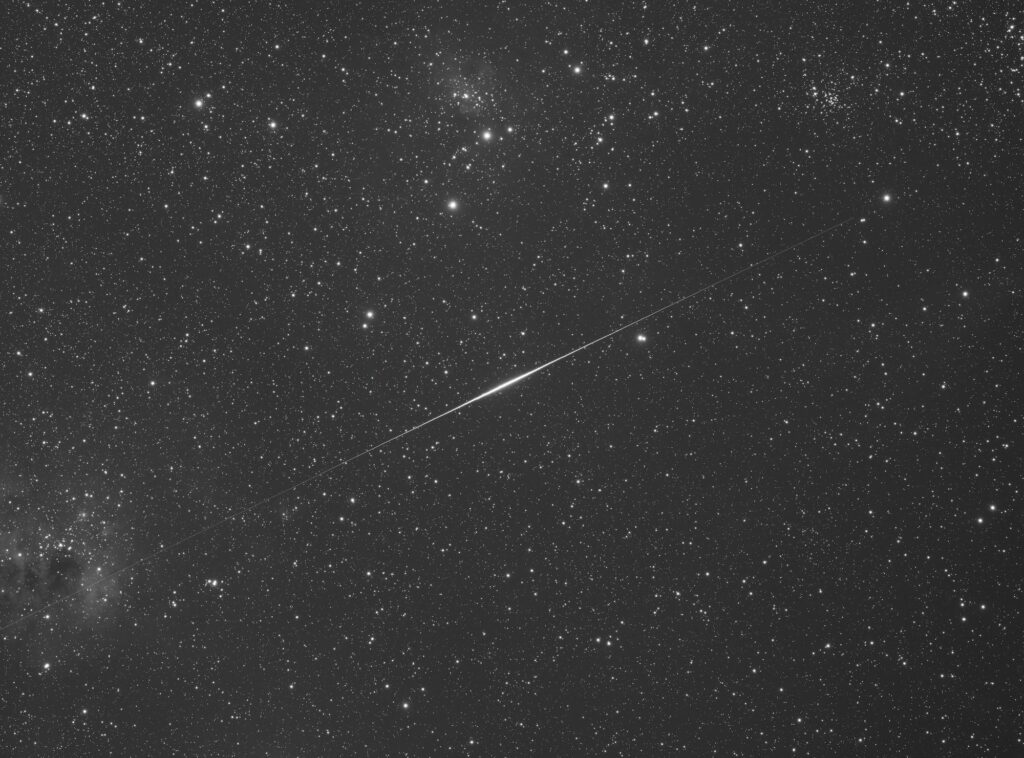
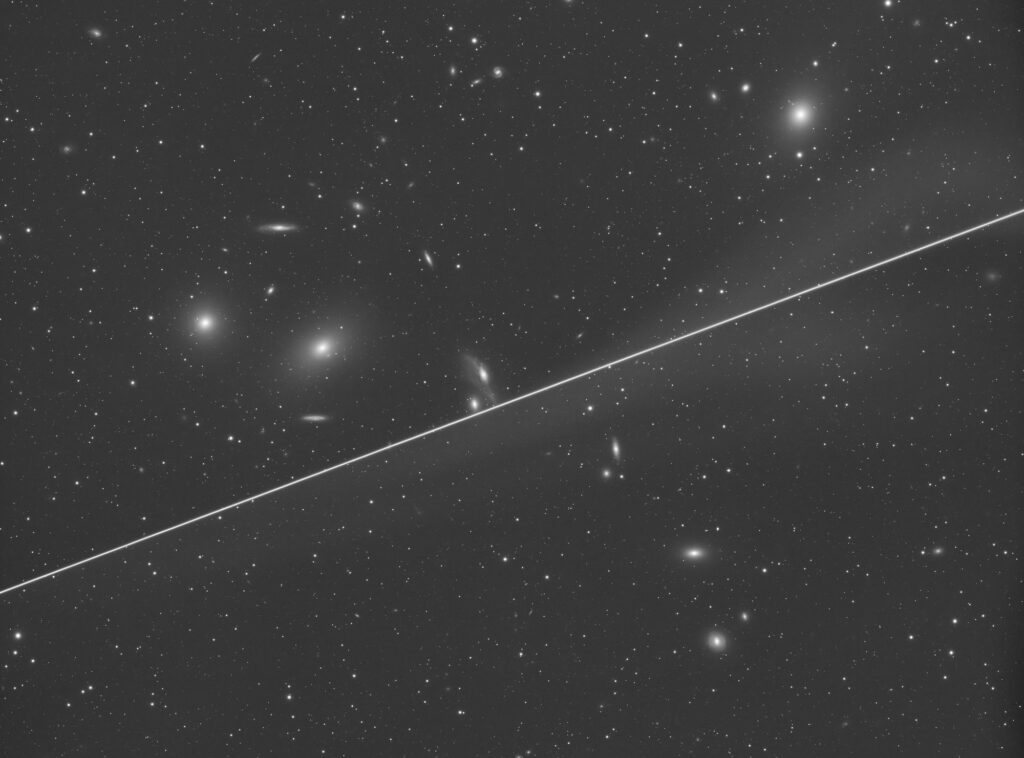
Below are two meteors caught by my telescope UDRO while imaging deep-space objects. While these are not members of the Perseid shower, they give a closer look at the dazzling streaks that will light up our sky in a couple of days.