
Have you ever been told that stars twinkle but planets do not, as a way to tell them apart in the night sky? Many of us in astronomy have heard this phrase and discounted it as merely folklore or a trick of the eye. However, there is actually some truth to this concept.
To understand why planets flicker less than stars, we need to understand what’s causing the flickering. That is, of course, atmospheric turbulence: the very effect that has forced large ground-based telescopes to the tops of mountains and facilitated innovation in adaptive optics. The atmosphere is anything but still. Uneven heating and cooling keep the air in constant motion, and layers moving at different speeds and temperatures shear past one another and mix turbulently. The result is a churning sea of air pockets, each with a slightly different temperature, density, and therefore refractive index, all shifting from one instant to the next.
When this turbulence affects starlight, it causes two distinct problems for astronomers: astronomical seeing and scintillation. These two effects are often conflated, used to explain star bloating in astrophotography images and twinkling alike. Let’s first talk about atmospheric seeing, and then move on to scintillation in order to uncover why stars appear to twinkle but planets do not.
Atmospheric Seeing
Stars are so far from Earth that their light arrives as a point source. With an idealized camera, no atmosphere in the way, and ignoring the effects of diffraction, a star would occupy just a single pixel. However, imaging tells a different story. My own rig records a star spread across anywhere from 10 to more than 100 pixels, depending on its brightness and the exposure length. This spatial smearing is known as atmospheric seeing, and the bloating in our images is caused by a time-averaging effect. The shifting refractive indices of the atmosphere bend light rapidly, making a point source dance and deform. This motion occurs on the time scale of a fraction of a second, and our images are minutes in length. The frantic dancing and constantly changing shape of the star blur together into a bloated profile across multiple pixels. Next time you’re imaging, try dropping the exposure length to see this atmospheric effect more clearly.
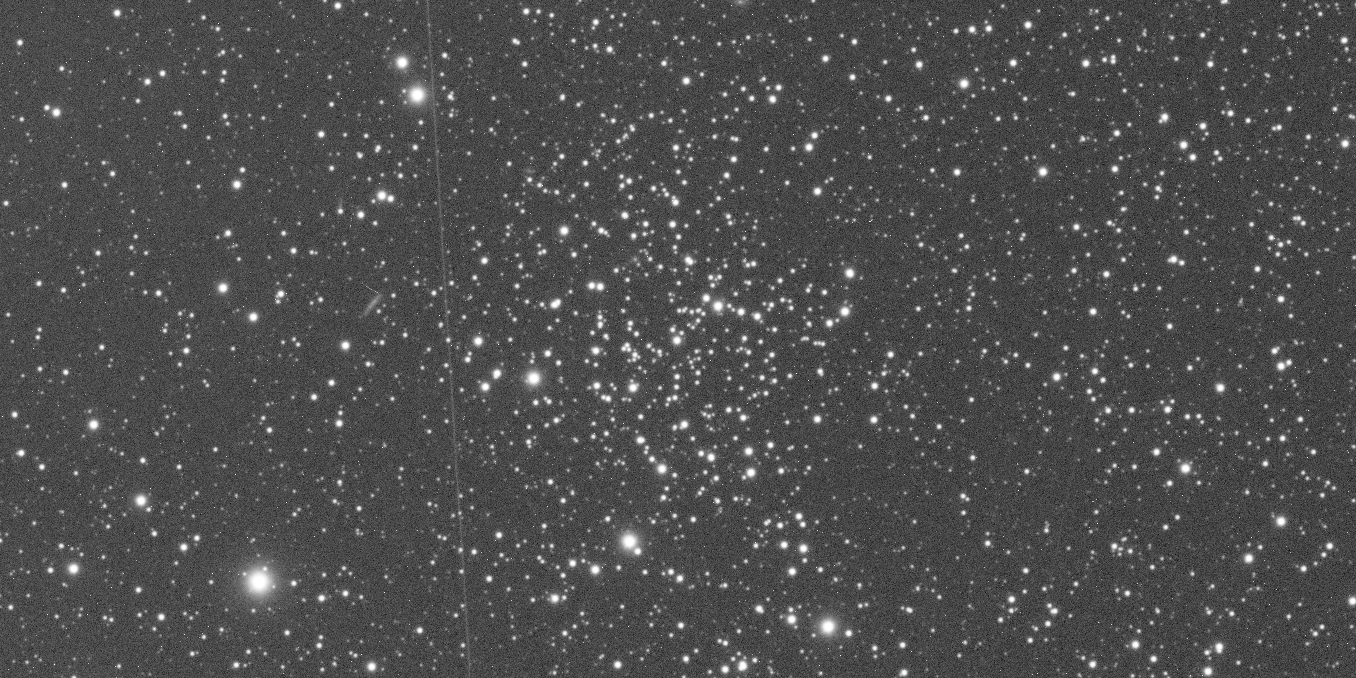
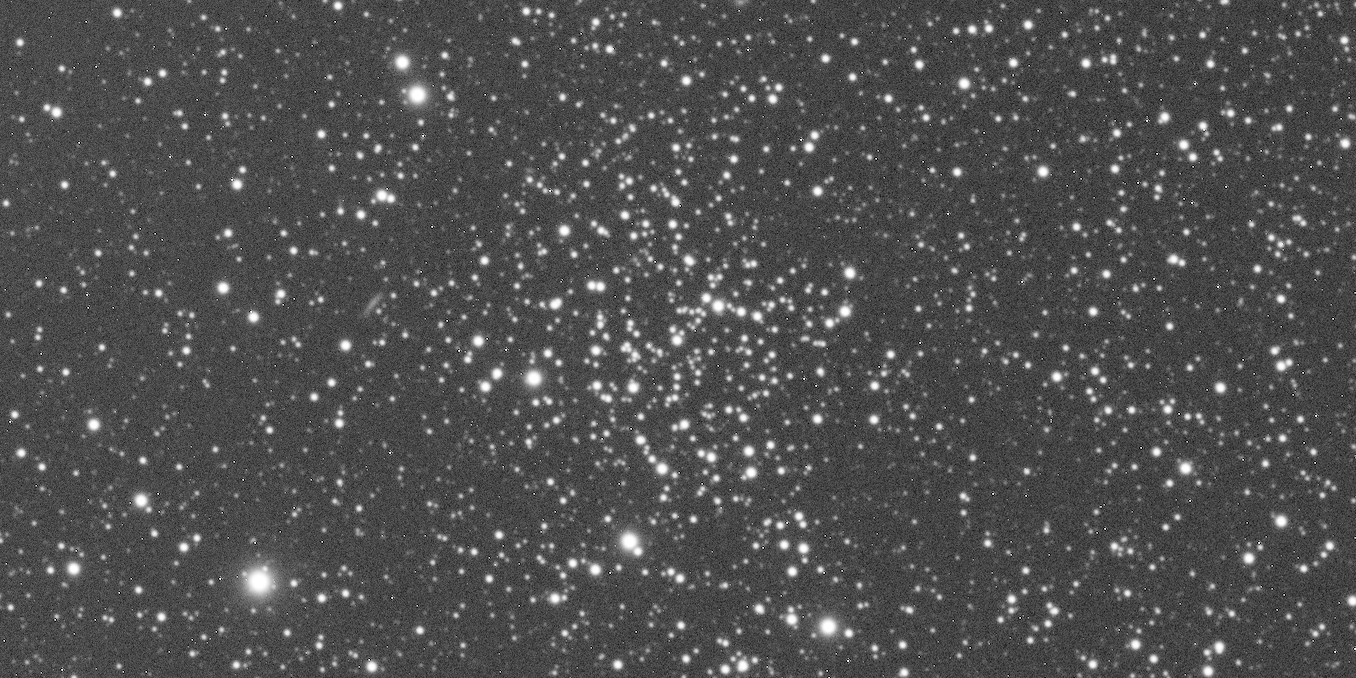
The subtle difference between an image taken under good astronomical seeing versus bad seeing.
Scintillation
Scintillation, on the other hand, is the actual “twinkling” we see with our eyes. Interestingly enough, scintillation becomes harder to observe the larger the aperture of the telescope. This gives us an important hint. Because your eye is so small, it only looks through a single pocket of air at any given millisecond. Turbulence at high altitude acts like a series of tiny, rapid lenses that focus the starlight directly into your eye one moment (making it bright) and refract it away the next (making it dim). A telescope has trouble observing this effect due to its large light-collecting surface. A larger surface allows light rays to reach the telescope that have passed through different air columns. Since these air columns are independent of each other, the dimming or brightening is no longer universal. One air column may have a dimming effect while another has a brightening effect, and these two cancel each other out.
Though physically dwarfed by even a modest star, a planet sits close enough to Earth to show a small disk rather than a point. This disk spans a few arcseconds in the case of Mars and tens of arcseconds for Venus or Jupiter. The idea is to picture that disk not as a single source of light but as a mosaic or group of countless tiny points crowded side by side. This lets us apply the logic of star scintillation to planets. Because the planet’s light cone is wider than a single air pocket, the light from the left side of, say, Jupiter passes through one air pocket, while the light from the right side passes through a completely different, independent air pocket right next to it. This leads to situations like the following:
- Light from Jupiter’s left edge that just got brightened by Air Pocket A.
- Light from Jupiter’s right edge that just got dimmed by Air Pocket B.
- Light from Jupiter’s center that remained unchanged by Air Pocket C.
Your eye can’t see the sides of Jupiter independently, but rather just the overall intensity of light emitted. Therefore, in the above situation, the intensity of Jupiter would remain unchanged. This is why planets do not appear to twinkle: multiple air pockets have averaged out the change in brightness caused by changing atmospheric refraction.
This, of course, is not always true. Nights with particularly strong turbulence can cause flickering, even in planets, and lower elevations add another layer to the story. When an object sits low on the horizon, its light must pass through more atmosphere, which amplifies the effects of differential atmospheric refraction.
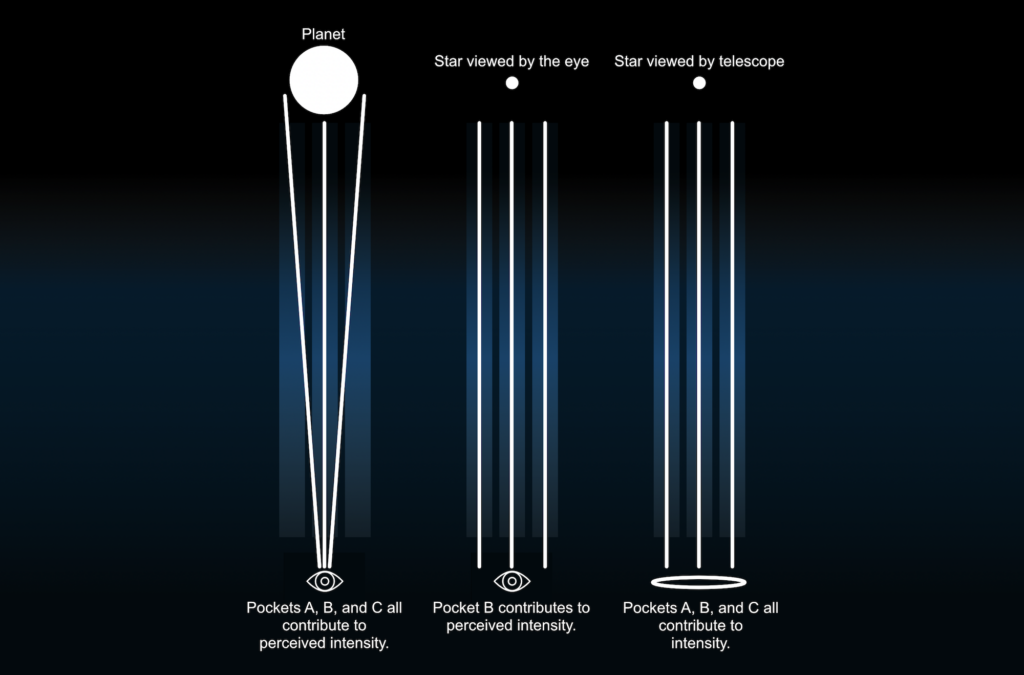
All effects discussed in the above section are illustrated in this figure. In Panel 2, only the light beam that travels through pocket B reaches the eye. In Panel 3, the telescope’s aperture is wide enough to capture the parallel rays passing through pockets A, B, and C.