
By Jett Peters
The Horsehead and Flame Nebula region is one of the most photogenic in the night sky. The red of ionized hydrogen, the gray dust of the Horsehead, and the tan tones of the Flame make a striking contrast.
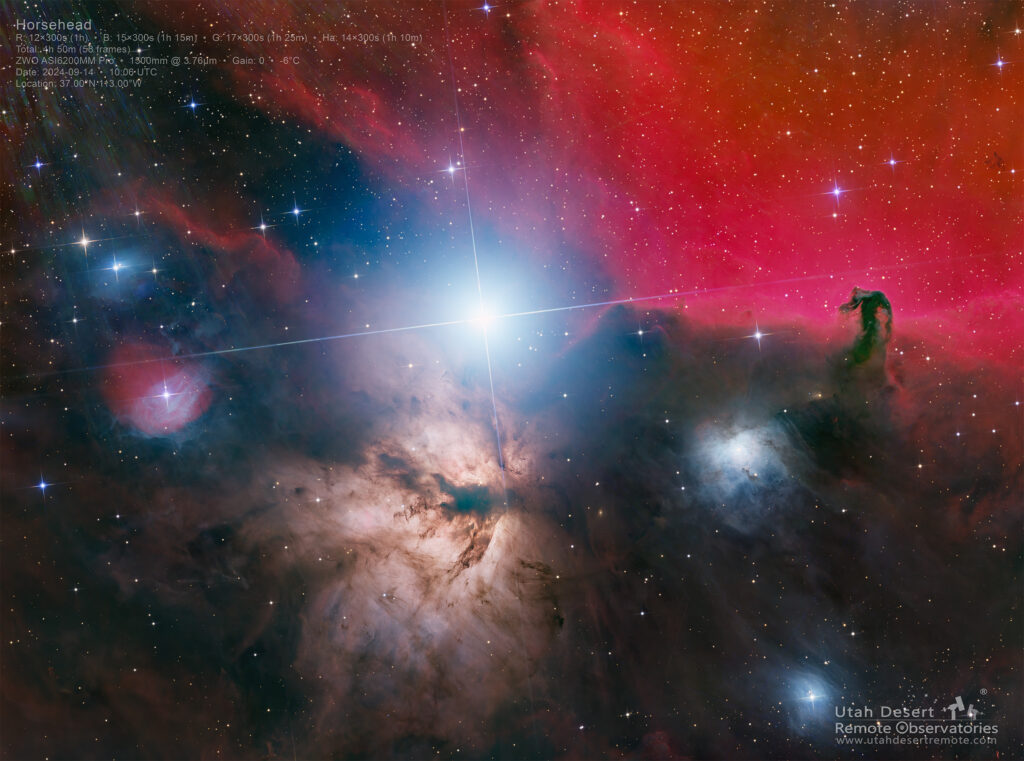
This image by Craig Stocks shows each part of the region in fine detail, with Alnitak shining in the middle. It combines nearly 5 hours of RGB and Hα data taken with a 16″ Dream Astrograph in a two-panel mosaic.
The Horsehead Nebula is only the dust pillar itself, not the crimson glow behind it, although the two are physically connected. The glowing hydrogen belongs to IC 434, an emission nebula sitting directly behind the Horsehead.
A common misconception is that Alnitak, the belt star, is responsible for the region’s intense emission. However, Alnitak doesn’t actually sit among the Horsehead and Flame; it only appears that way from our perspective. The stars that produce the red glow of IC 434 are, quite frankly, more interesting. Sigma Orionis is a five-star system (that’s five stars bound together by gravity) whose central pair, A and B, shine at about 35,000 and 30,000 times the Sun’s luminosity, respectively.
Moving over to the Flame Nebula, the real source of the nebula’s emission is a star called IRS 2b, which lies hidden within the thick dust at the center of the Flame. It was only identified in 2003, when astronomers peered into the nebula’s dusty depths with near-infrared light, whose wavelengths can pierce the dust clouds.
An underappreciated member of the region is NGC 2023, the blue glow below and to the left of the Horsehead. It is a reflection nebula, and one of the largest in the night sky at that. The nebula is lit by the star HD 37903, the most luminous member of the same molecular cloud the Horsehead belongs to. One study suggests the star formed when two gas clouds collided, triggering the birth of HD 37903 along with about 20 smaller stars.