By Jett Peters
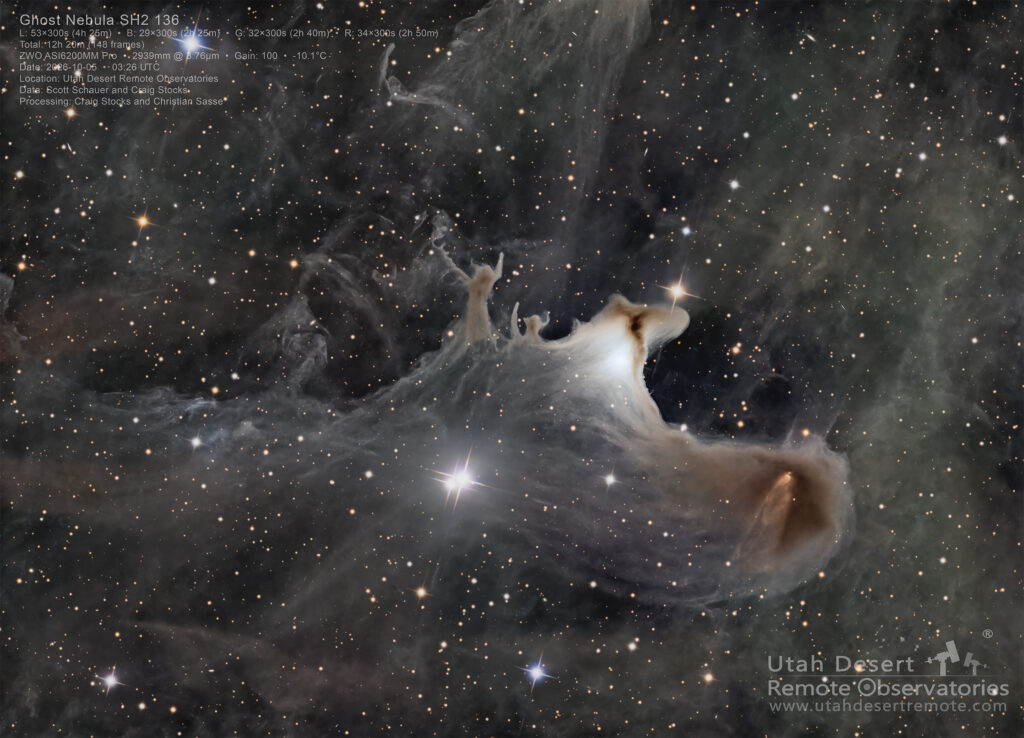
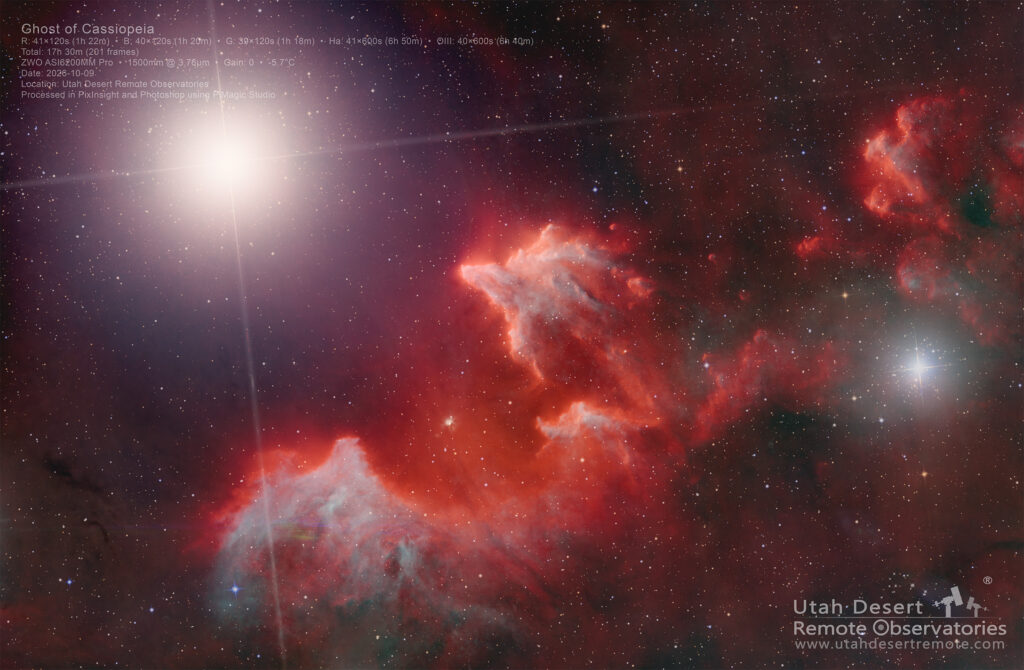
Both nebulae go by the name “Ghost,” but Sh2-185 and Sh2-136 share little visual similarity.
Sh2-185, the “Ghost of Cassiopeia,” has been covered before on this blog, but this detail-rich composition by Craig Stocks sheds new light on the object’s true structural complexity. In wider-field images of the region, the cloud appears to be dominated by red hydrogen emission, but the Ghost of Cassiopeia is in large part a reflection nebula, trimmed with glowing hydrogen where ultraviolet light from Gamma Cassiopeiae ionizes the cloud’s surface. The reflection components are the blue-grey dust, while the ionized gas shows up as the crimson outlines.
Gamma Cassiopeiae is also on display in the image, with large diffraction spikes cast by the Dream 16″ astrograph. The star makes this region one of the most technically challenging to post-process. While it wreaks havoc on long-exposure photography, the star is of great scientific interest. Spinning at roughly 1.6 million km/h at its equator, Gamma Cas frequently throws off matter, which changes its brightness. Over the past century, it has ranged from an eye-watering magnitude 1.6 to a dimmer 3.0.
Sh2-136, on the other hand, is a true reflection nebula, lit primarily by starlight from BD+67 1300 scattering through the surrounding dust. The cloud is made up of dense tendrils of dust set against a fainter, wispy dust background. Sh2-136 sits in the constellation Cepheus, nestled within the greater Cepheus Flare molecular cloud complex. The Ghost is small, so it benefits from a long-focal-length instrument. The image shown here was captured by Scott Schauer and Craig Stocks at 2939 mm under the dark skies of UDRO. The composition also captures CB 230, the Bok globule within the Ghost. Bok globules are small, dense clouds of cold gas and dust that collapse under their own gravity to form new stars. This ghostly nebula, despite its appearance, is actively giving birth to the stars that will light the universe of tomorrow.