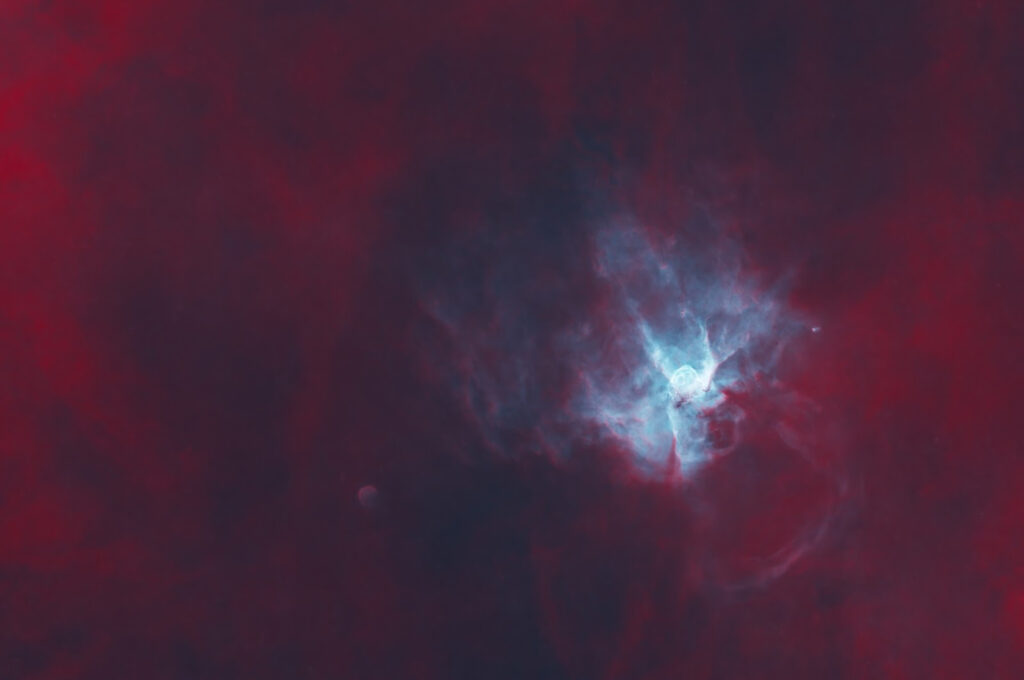
By Jett Peters
Early this winter, we covered a number of intriguing winter targets that are significantly more unique than Orion’s standard offerings. One of these nebulae was the Thor’s Helmet, which resides in the constellation Canis Major, next to the vast emission of the Seagull Nebula.
Like the Crescent Nebula, Thor’s Helmet gets its bizarre structure from the mechanism that drove its formation. Thor’s Helmet is a Wolf-Rayet nebula, which has become somewhat of a theme on this blog (check out our post on these eccentric stellar giants). The star responsible in the case of Thor’s Helmet is WR 7, which is thought to be roughly 280,000 times brighter than the Sun and about 16 times as massive.
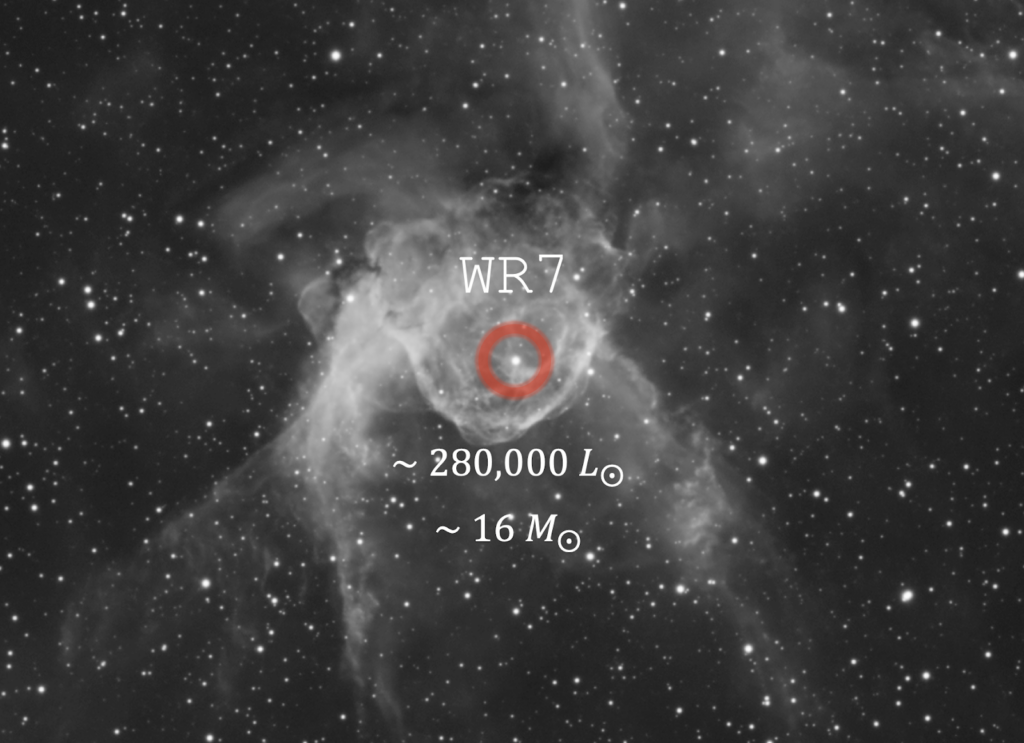
The nebula was discovered by William Herschel on January 31, 1785, and was the first Wolf-Rayet nebula to be discovered. This early discovery date is in part due to its luminosity. While the outer wing-like filamentary structures are quite faint, the core bubble is very bright, especially in narrowband. As mentioned in the winter targets blog, this is an HOO target, meaning its primary modes of emission are ionized hydrogen and oxygen. The hydrogen shows up as sharp, bright filaments that define the wing-like structure, while the oxygen fills in the region between the filaments.
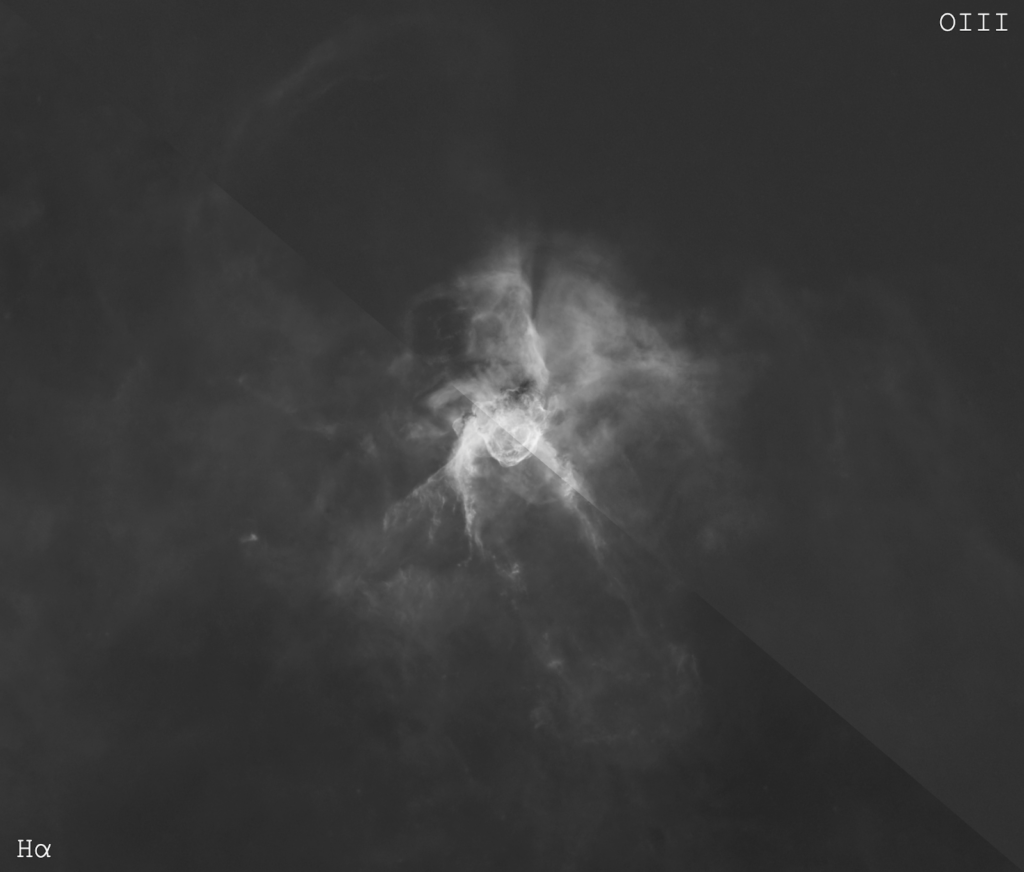
Once a large amount of hydrogen and oxygen data is collected, processing this target is straightforward but slightly deceiving. While only two channels are informed, and a starting point can be obtained from a simple pixel math operation, coaxing out detail from the cloud while keeping it within the core bubble is tricky. Noise reduction is a must for this target, as even with tens of hours of data in each filter, signal in the outer reaches is hard to come by.
A forty-hour HOO composition taken with the Esprit 100 under the dark skies of UDRO can be seen below.