
By Jett Peters
The Spider Nebula or IC 417 and its close neighbor NGC 1931 reside in the constellation of Auriga. Unlike most targets in this region of the sky, these two are not purely emission nebulae; rather, they are reflection nebulae with emission components. Located in the same region as the Tadpole and Flaming Star, these two smaller nebulae are often overlooked or included merely on the edge of the wide-field image.
While they lack the scale and bright emission characteristics of the Tadpole and Flaming Star, they present a unique aesthetic that is especially potent with a longer focal-length telescope. The interaction between dust and gas and subtle differences between hydrogen emission and red broadband emission are only found in a handful of targets.
While this target is partially interesting to the long-focal-length observer, it can be included as an additional gem in the larger nebula complex if it is treated properly. With a shorter focal-length telescope like the Esprit 100 used to capture this image, it is possible to include one of the more famous objects in Auriga while still giving the Spider and NGC 1931 the attention they deserve.
Processing this region is quite tricky as mixing RGB with narrowband does tend to be the hardest technique to pick up. The overall workflow is similar to processing an L, R, G, B, Ha composition of the Cocoon Nebula which we tackled in a previous blog.
In addition, while the greater nebula complex is often only shot in narrowband, this method will not show any of the unique attributes of the Spider. It’s necessary to shoot a significant amount of brought-band data, with the majority being luminance.
The below image consists of 13 hours of Ha, 5 hours in each R, G, B filter, and 10 hours in L.
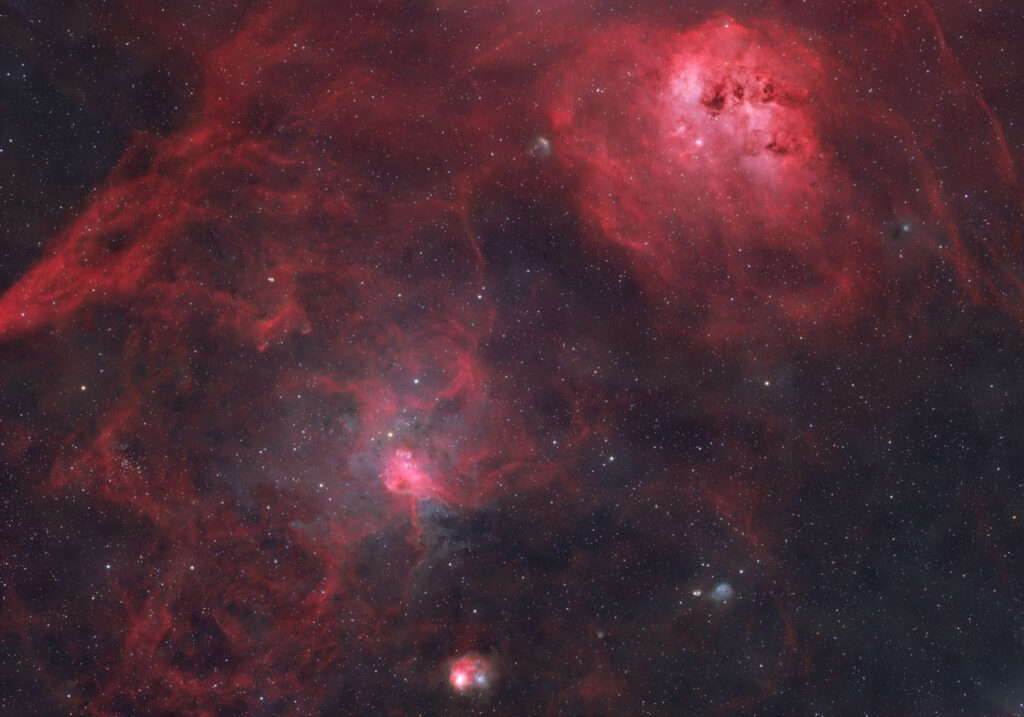
This image, as is usually the case with my projects, is a work in progress. A particularly tricky part of a composition of this nature is adding the Ha in a way that does not diminish the detail of already bright parts of the image. The Tadpole Nebula is bright in RGB, so adding hydrogen over the top, tends to degrade detail.